History of Brunei Darussalam
From Ancient Borneo Kingdoms to a Modern Islamic Sultanate — A Complete Chronological Journey
Pre-Islamic Period (Before 14th Century)
Long before the arrival of Islam, the territory of modern Brunei was part of a network of coastal and riverine settlements inhabited by Austronesian peoples. Archaeological evidence suggests human presence in northern Borneo dating back at least 40,000 years.
Early Settlements and Trade
By the first millennium CE, the northern coast of Borneo had become a node in regional trade networks linking China, India, and the Malay Archipelago. Chinese records from the Song Dynasty (960–1279 CE) mention a kingdom called "P'o-ni" (渤泥), widely identified with Brunei. These accounts describe a polity that sent tribute missions to China and engaged in commerce involving camphor, rattan, pearls, and bird's nests.
During this era, local beliefs centered on animism and ancestor worship. Indigenous communities revered nature spirits, practiced rituals to honor the dead, and lived in longhouses under local chieftains. Hindu and Buddhist influences from Java and Sumatra began to filter in, as the Srivijaya empire (7th–13th centuries) extended its maritime influence across Borneo. However, unlike much of insular Southeast Asia, Brunei never fully adopted Hinduism or Buddhism as state religions; instead, these influences blended with local traditions.
The Legacy of Awang Semaun
Oral traditions speak of Awang Semaun, a legendary warrior and folk hero who, along with his brothers, established settlements along the Brunei River. These stories, preserved in the Silsilah Raja-Raja Brunei (Genealogy of the Brunei Sultans), describe a confederation of riverine communities that would later form the nucleus of the Bruneian sultanate.
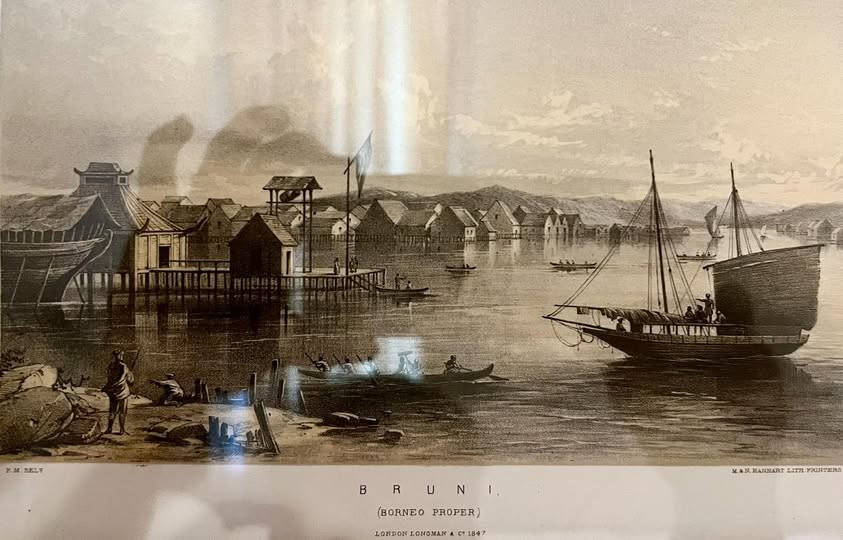 [Artistic reconstruction: Early Brunei River settlements, c. 12th–13th century]
Islamization and the Birth of the Sultanate (14th–15th Centuries)
The adoption of Islam transformed Brunei from a loosely organized chiefdom into a centralized sultanate that would dominate northern Borneo for centuries.
The Conversion of Sultan Muhammad Shah (1363–1402)
According to the official royal chronicle, the first Muslim ruler of Brunei was Awang Alak Betatar, who converted to Islam after marrying a princess from the Sultanate of Johor. He took the title Sultan Muhammad Shah, marking the formal beginning of the Sultanate of Brunei around 1368. Some sources suggest Islamic influence arrived earlier via Arab and Indian traders, but the conversion of the ruler cemented Islam as the state religion.
Expansion Under Sultan Ahmad and Sultan Sharif Ali
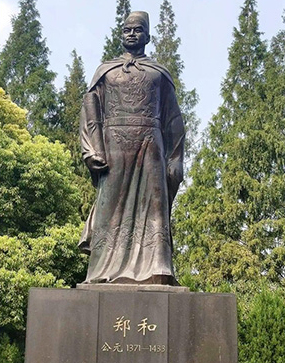
Under Sultan Ahmad (1408–1425), Brunei strengthened diplomatic ties with China. In 1408, Sultan Ahmad sent a tribute mission to the Ming Emperor Yongle, and the relationship flourished. The third sultan, Sultan Sharif Ali (1425–1432), was an Arab scholar from Taif (modern-day Saudi Arabia) who married a Bruneian princess. He introduced Islamic laws, built mosques, and is credited with creating the first Kris (ceremonial dagger) symbolizing Bruneian sovereignty. His tomb in Bandar Seri Begawan remains a pilgrimage site.
By the mid-15th century, Brunei had adopted the Malay Islamic Monarchy (Melayu Islam Beraja) philosophy — a blend of Malay culture, Islamic teachings, and monarchical governance that remains the national ideology today.
The Golden Age of Brunei (15th–17th Centuries)
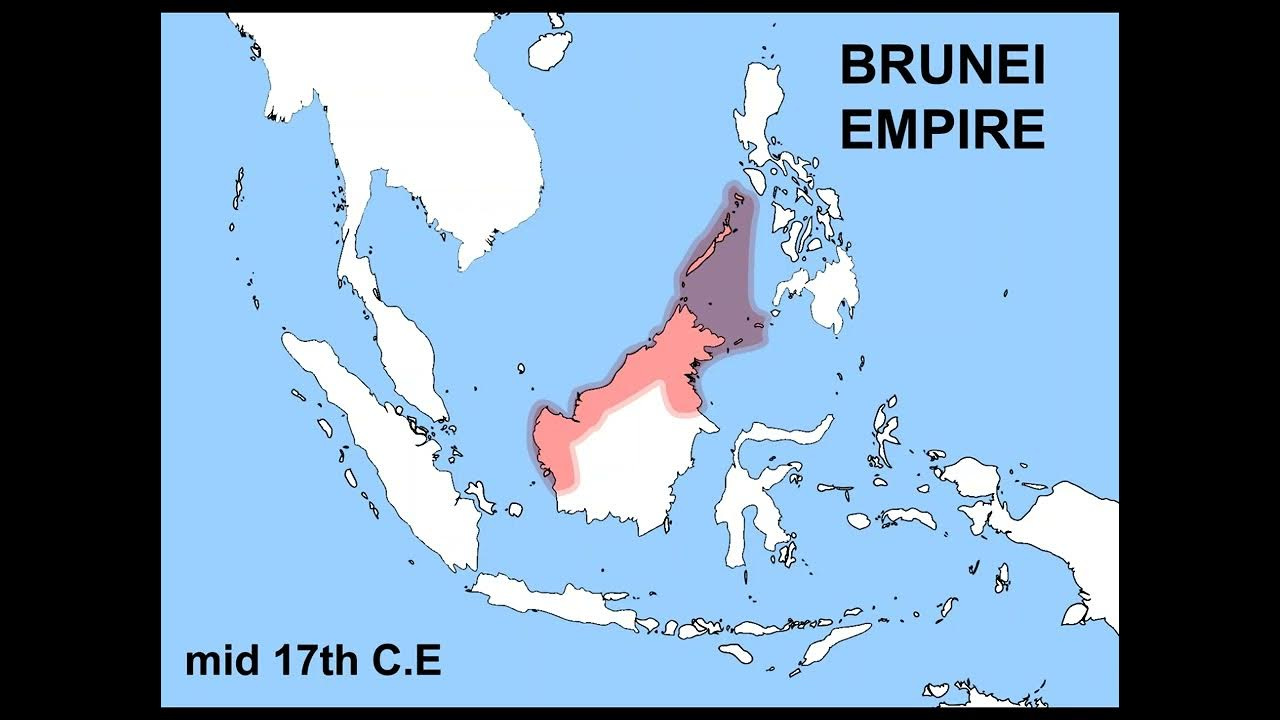
Under Sultan Bolkiah (1485–1524) and his successors, Brunei reached its territorial zenith, controlling much of Borneo, the Sulu Archipelago, and parts of the Philippines.
Sultan Bolkiah (The Singing Captain, 1485–1524)
Often considered the greatest Bruneian ruler, Sultan Bolkiah extended the sultanate's influence across Borneo to Seludong (modern Manila), the Sulu islands, and as far south as the Makassar Strait. His navy controlled vital trade routes, making Brunei a regional superpower. European accounts describe Brunei as a wealthy, well-organized kingdom with a flourishing port city.
Trade, Culture, and Administration
During this era, Brunei's economy thrived on the spice trade, particularly pepper, camphor, and sago. Chinese, Portuguese, Spanish, and Malay merchants anchored at the Brunei River port. The sultanate developed a sophisticated hierarchical administration, with Pengirans (princes), Wazirs (ministers), and Manteris (chiefs). Islamic scholarship flourished, and the Arabic script (Jawi) was widely used for legal and literary texts.
The Batu Tarsilah, a stone inscription dated 1632, records the genealogy of the early sultans and remains an important historical artifact.
📉 Decline and European Encroachment (17th–19th Centuries)
From the mid-17th century, internal strife, European colonial expansion, and the rise of competing powers eroded Brunei's once-vast empire.
Civil Wars and Loss of Territories
The Brunei Civil War (1660–1673), fought between Sultan Abdul Hakkul Mubin and Muhyiddin (the Bendahara), devastated the kingdom. Muhyiddin requested military aid from the Sultan of Sulu, promising to cede eastern Borneo territories in return. Although Muhyiddin won, Brunei never regained full control over Sabah and the Sulu islands. The War of the Three Sultans (1690–1700) further weakened the monarchy.
Meanwhile, the Spanish attacked Brunei in 1578, capturing the capital briefly before withdrawing due to disease. Though a temporary setback, it signaled European interest in the region.
The Arrival of James Brooke and the White Rajahs
The most devastating blow came from a British adventurer, James Brooke. In 1841, Brooke helped the Sultan of Brunei suppress a rebellion in Sarawak, and as a reward, he was granted the title of Rajah of Sarawak. Over the following decades, Brooke and his successors systematically annexed Brunei's territories, including the Limbang Valley in 1890, cutting the sultanate in two.
Fearing complete absorption by the Brookes or other European powers, Sultan Hashim Jalilul Alam Aqamaddin (1885–1906) appealed to Britain for protection.
🇬🇧 British Protectorate and the Residency System (1888–1941)
In 1888, Brunei became a British protectorate, retaining nominal sovereignty while surrendering foreign affairs and defense to London. A British Resident was appointed in 1906 to advise the sultan on all matters except Islamic religion and Malay custom.
Political and Economic Changes
The Residency system modernized administration, established schools, and introduced rubber cultivation. However, it also sidelined the sultan's authority and marginalized traditional elites. Many Bruneians resented British control, though direct resistance was rare.
Oil extraction began in earnest in the 1930s, bringing unprecedented wealth. The British-run Brunei Shell Petroleum company dominated production. By 1941, oil revenues were funding infrastructure, healthcare, and education, but the wealth flowed largely to the colonial administration.
Japanese Occupation (1941–1945)
On 16 December 1941, Japanese forces landed in Brunei, quickly overwhelming the small British garrison. The occupation was a brutal period of suffering, forced labor, and scarcity.
Life Under the Rising Sun
The Japanese military administration renamed Brunei "Borneo Baru" (New Borneo) and sought to exploit its oil fields. Local Chinese faced the worst persecution, suspected of supporting the Allies. Many were executed or sent to labor camps. Sultan Ahmad Tajuddin was forced to pay a large tribute and endure humiliation. Food supplies dwindled, and the population endured severe malnutrition.
Allied bombing raids targeted the oil installations at Seria and Kuala Belait from 1944 onwards, causing extensive damage and civilian casualties.
The occupation shattered the myth of British invincibility and fueled nationalist sentiments that would later drive the independence movement.
Post-War Reconstruction and the Path to Independence (1945–1984)
After the war, Britain resumed control but faced rising demands for self-rule. The discovery of massive offshore oil fields in the 1950s filled state coffers, enabling social reforms.
The 1959 Constitution
In 1959, a new constitution was promulgated, granting Brunei internal self-government. The British retained responsibility for foreign affairs and defense. Sultan Omar Ali Saifuddien III (reigned 1950–1967) is remembered as the "Architect of Modern Brunei" for his prudent management of oil wealth and his rejection of merger with Malaysia.
The 1962 rebellion, led by A.M. Azahari, was crushed with British military assistance. In response, Sultan Omar Ali declared a state of emergency, suspended elections, and banned political parties — a state of emergency that would last until 2011.
Rejecting the Malaysian Federation
While neighboring Sabah, Sarawak, and Singapore joined Malaya to form Malaysia in 1963, Brunei opted out. The sultan cited disputes over oil revenue and the status of the monarchy. Despite British pressure, Brunei remained a British protectorate.
Full Independence
On 1 January 1984, Brunei Darussalam (meaning "Abode of Peace") became a fully independent nation. Sultan Hassanal Bolkiah, who had ascended the throne in 1967, proclaimed himself Prime Minister, Defense Minister, and Finance Minister — a concentration of power that continues today.
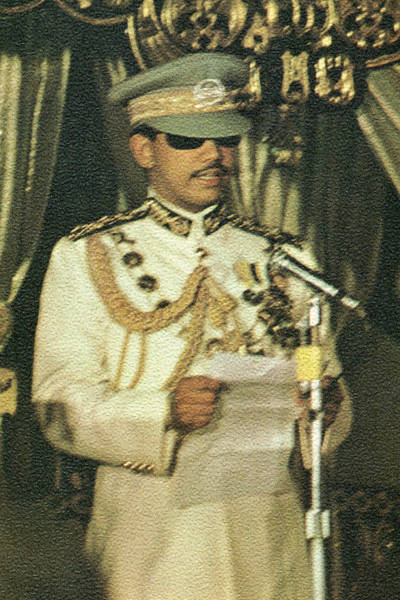 [Photo: Sultan Hassanal Bolkiah declaring independence on 1 January 1984]
🏙️ Modern Brunei Darussalam (1984–Present)
Since independence, Brunei has pursued a conservative, oil-dependent development model, with the sultan maintaining absolute authority.
Economic Prosperity and Diversification
Oil and natural gas account for over 90% of exports and about 60% of GDP. High per‑capita income (among the highest in Asia) funds free healthcare, education from primary to university, and subsidized housing. However, reliance on hydrocarbons leaves the economy vulnerable to price fluctuations. Efforts to diversify into halal tourism, Islamic finance, and technology have progressed slowly.
Implementation of Sharia Law
In 2014, Brunei became the first East Asian country to introduce a comprehensive Sharia penal code, including severe penalties such as amputation for theft and stoning for adultery. The move drew international condemnation, particularly from the UN and Western nations, but Sultan Hassanal Bolkiah has defended it as consistent with Brunei's Islamic identity.
Political Structure and Criticism
Brunei is an absolute monarchy. No national elections have been held since 1962. Political parties are banned or dormant. The sultan appoints all key officials, judges, and legislative council members. Human rights organizations regularly criticize Brunei for censorship, lack of press freedom, and discrimination against LGBTQ+ individuals.
Foreign Relations
Despite its small size, Brunei plays an active diplomatic role. It joined ASEAN in 1984, hosted the ASEAN summit in 2013, and maintains close ties with oil‑buying nations, particularly Japan, South Korea, and China. The sultan is a prominent voice in the Organisation of Islamic Cooperation (OIC).
In recent years, Brunei has sought to attract tourism, promoting its pristine rainforests, the opulent Istana Nurul Iman (the world's largest residential palace), and the water village of Kampong Ayer — a continuous settlement on the Brunei River for over 1,300 years.
Legacy and Future Challenges
Brunei's history is a remarkable story of resilience: from a pre-Islamic trading hub, to a powerful thalassocratic empire, to a tiny oil-rich state navigating modernity while preserving tradition.
- Reducing dependence on oil and gas through economic diversification.
- Managing youth expectations and providing sufficient employment.
- Balancing conservative Islamic values with international human rights standards.
- Preserving Brunei's unique Malay Islamic Monarchy identity in a globalized world.
As the nation approaches its fifth decade of independence, the House of Bolkiah — the world's longest-ruling continuous royal dynasty — remains firmly in control. Whether Brunei can adapt to the post‑oil era while retaining its cultural distinctiveness will define its next chapter.